

LC7537AN Datasheet – Electronic Volume Control System
Electronic Volume Control System for Audio Equipment
Package DIP 42 Pin Type
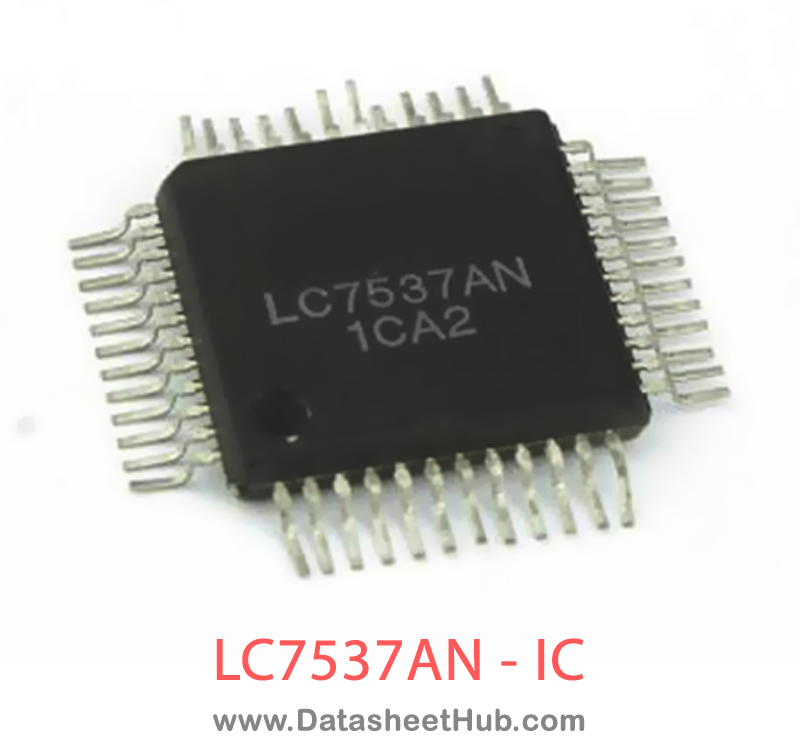
LC7537AN overview
The LC7537AN is an Electronic Volume Control System for Audio Equipment made by Sanyo, supplied in a DIP 42 Pin Type package. The absolute maximum ratings table on this page lists the 4 limits from the manufacturer's datasheet that must not be exceeded. This page brings together the LC7537AN pinout and maximum ratings, with the full datasheet PDF to preview below or download.
The LC7537N is an electronic control LSI capable of electronically controlling the volume, balance, loudness, fader, bass, and treble functions individually with fewer externally connected component parts.
Datasheet
lc7537an-datasheet.pdf
LC7537AN features
- Enables controlling the below-listed functions with 3- line serial data, including CE, DI, and CLK. Also, due to 0 V to 5 V swing of the serial data input voltage, permits the use of a general purpose microcomputer.
- Volume : Separately controls the Lch and Rch volume levels across 81 positions over the 0 dB to –79 dB (in 1 dB steps) range and –¥, and consequently also serves balance control purposes.
- Loudness : By virtue of a center tap provided at the
- –20 dB position of the volume controlling ladder resistors, permits loudness to be controlled with externally connected CR components.
- –20 dB range, and 5 dB steps over the
- –20 dB to –45 dB range, and at –¥, for a total of 16 positions).
- By virtue of its CMOS structure, the LSI operates under a broad power supply voltage range from +4.5 V to +15 V, permitting the use of either a single or a dual ± power supply, whichever is preferred.
LC7537AN pinout
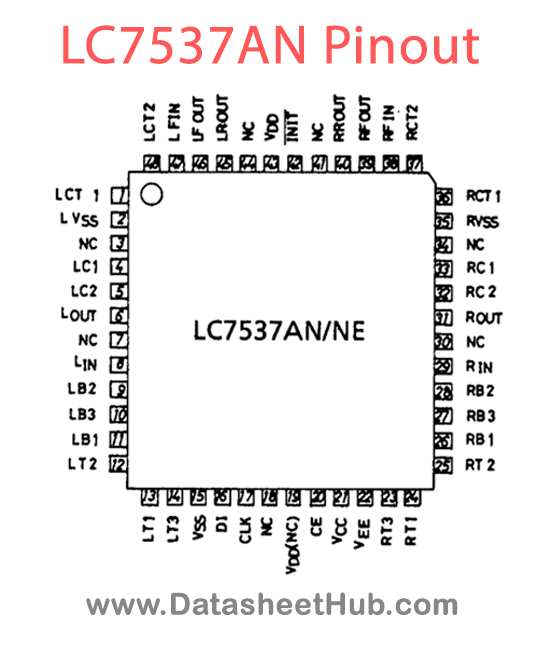
| Pin | Name | Description |
|---|---|---|
| 12(8) | L.IN | Main volume control block 5 dB-step attenuator input terminals. These pins should be driven at a low impedance. |
| 31(29) | R.IN | |
| 9(4) | L.C1 | Main volume control block 5 dB-step attenuator output terminals. Having been designed to be open, the step positions will develop errors if at low acceptor impedances, so that as high load impedances as possible should be provided. |
| 34(33) | R.C1 | |
| 10(5) | L.C2 | Main volume control block 1 dB-step attenuator input terminals. Theses pins should be driven at alow impedance. |
| 33(32) | R.C2 | |
| 11(6) | L.OUT | Main volume control block 1 dB-step attenuator output terminals. Due to the step positions designed to be open, load impedances as high as possible should be provided to them, similar to those for the LC1 and RC1. |
| 32(31) | R.OUT | |
| 5(47) | L.FIN | Fader functions employing mode input terminals. These pins should be driven at a low impedance. |
| 38(38) | R.FIN | |
| 4(46) 3(45) 39(39) 40(40) | L.FOUTL.ROUT R.ROUTR.ROUT | Fader block output terminals. These pins permit the front and rear sides to be faded out independently of each other. Attenuations exercised on Lch will be the same as on Rch. Due to the step positions designed to be open, acceptor impedances as high as possible should be provided to them. |
| 15(11) 16(9) 14(10) 28(26) 27(28) | L.B1L.B2L.B3R.B1R.B2R.B3 | Bass tone control block terminals. steps |
| 17(13) 16(12) 18(14) 26(24) 27(25 | L.T1L.T2L.T3 R.T1R.T2R.T3 | Treble tone control block terminals. A total of 15 positions have been provided in 2 dB steps. The VR resistance value is 20 kW. |
| 7(1) 6(48) 36(36) 37(37) | LCT1LCT2 RCT1 RCT2 | Loudness dedicated terminals. A high-frequency-range correcting C should be put between CT1 and IN, and low-frequency-range correcting C between CT2 and L–VSS (R–VSS). |
Absolute maximum ratings
| Parameter | Symbol | Value | Unit | Conditions |
|---|---|---|---|---|
| Maximum supply voltage | VDD – VEE max | 16 | V | VDD, VEE : VEE ³ –8 V |
| Allowable power dissipation | Pd max | 200 | mW | Ta £ 85˚C, (LC7537N, 7537AN) |
| Operating temperature | Topr | –40 to +85 | ˚C | |
| Storage temperature | Tstg *3 | –50 to +125 | ˚C |
LC7537AN applications
- Audio Signal Processor
- Car Audio Systems
- Digital-to-Analog Converter (DAC)
- Electronic Music Instruments
Comments 0
Leave a comment