

NT68F62 Datasheet PDF – 8-Bit Microcontroller for Monitor
8-Bit Microcontroller for Monitor (32K Flash MTP Type)
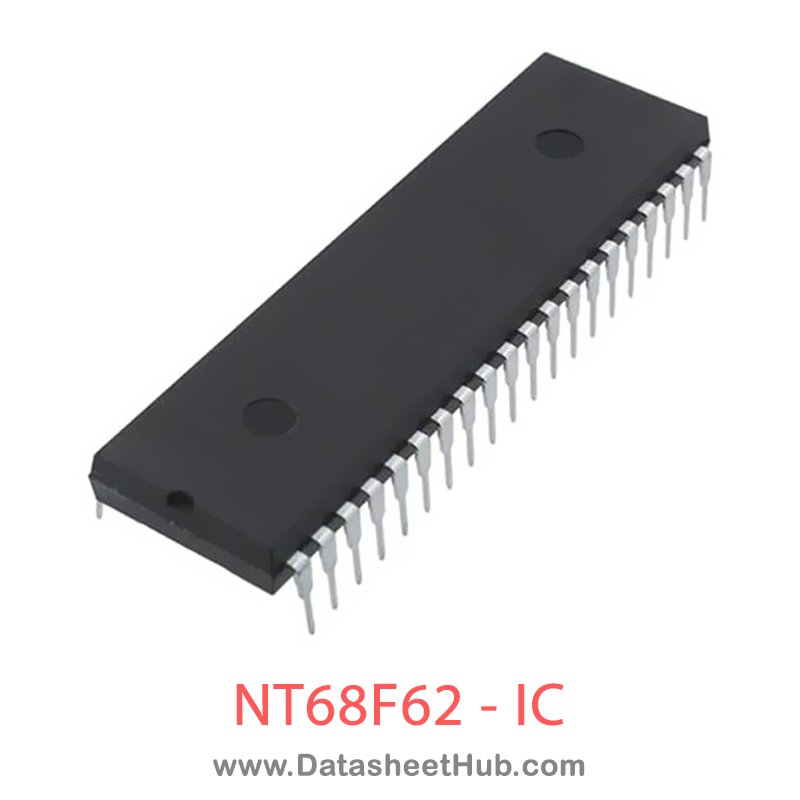
NT68F62 overview
The NT68F62 is an 8-Bit Microcontroller for Monitor (32K Flash MTP Type) made by Novatek Microelectronics, supplied in a 40-pin P-DIP and 42-pin S-DIP Type package. This page brings together the NT68F62 pinout, with the full datasheet PDF to preview below or download.
The NT68F62 is a new generation of monitor mC for auto- sync and digital control applications. Particularly, this chip supports various functions to allow users to easily develop USB monitors. It contains the 6502 8-bit CPU core, 512 bytes of RAM for use as working RAM and as stack area, 32K bytes of Flash memory, 13-channels of 8-bit PWM D/A converters, 4-channel A/D converters for detection of keys which can save I/O pins, one 8-bit pre-loadable base timer, an internal Hsync and Vsync signals processor and a watch-dog timer, which prevents the system from abnormal operation and two IIC bus interfaces. The user can store EDID data in the 128 bytes of RAM for DDC1/2B, so that the user can reduce a dedicated EEPROM for EDID. The half frequency output function can save the external one- shot circuit. All of these designs are borne of our commitment to offer our user savings on component costs. The 42 pin S-DIP IC provides two additional I/O pins – port40 & port41, Part number NT68F62U represents the S- DIP IC. For future reference, port40 & port42 are only available for the 42 pin S-DIP IC.
Datasheet
NT68F62 features
- Operating voltage range: 4.5V to 5.5V
- CMOS technology for low power consumption
- 6502 8-bit CMOS CPU core
- 8 MHz operation frequency
- 32K bytes of flash memory for Multi -Times Program
- 512 bytes of RAM
- 2Kbytes Masked BootROM for ISP.
- One 8-bit base timer
- 13 channels of 8-bit PWM outputs with 5V open drain
- 4 channel A/D converters with 6-bit resolution
- 25 bi-directional I/O port pins (8 dedicated I/O pins)
- Hsync/Vsync signals processor for separate & composite signals, including hardware sync signals polarity detection and freq. counters with 2 sets of Hsync counting intervals
- Hsync/Vsync polarity controlled output, 5 selectable free run output signals and self-test patterns, auto- mute function, half freq. I/O function
- Two built-in IIC bus interfaces support VESA DDC1/2B+
- Two layers of interrupt management NMI interrupt sources
- INTE0 (External INT with selectable edge trigger)
- INTMUTE (Auto Mute Activated)
- IRQ interrupt sources
- INTS0/1 (SCL Go-low INT)
- INTA0/1 (Slave Address Matched INT)
- INTTX0/1 (Shift Register INT)
- INTRX0/1 (Shift Register INT)
- INTNAK0/1 (No Acknowledge)
- INTSTOP0/1 (Stop Condition Occurred INT)
- INTE1 (External INT with Selectable Edge Trigger)
- INTV (VSYNC INT)
- INTMR (Base Timer INT)
- INTADC (AD Conversion Done INT)
- Hardware watch-dog timer function
- 40-pin P-DIP and 42-pin S-DIP packages
NT68F62 pinout

| Pin | Description |
|---|---|
| 1 | O |
| 2 | O |
| 3 | O |
| 4 | I |
| 5 | P |
| 6 | P |
| 7 | O |
| 8 | I |
| 9 | I/O |
| 10 | I/O |
| 11 | I/O |
| 12 | I/O |
| 13 | I/O |
| 14 | I/O |
| 15 | I/O |
NT68F62 applications
- Embedded System Control
- Industrial Automation
- Consumer Electronics Integration
- Smart Appliances Management
- IoT Device Control
Comments 0
Leave a comment